Researcher, Intelligent Data Engineering Lab (INDE Lab), Informatics Institute, University of Amsterdam
Email · CV · Google Scholar · ORCID · PhilPapers · GitHub · LinkedIn
I began my career in 1982 as a Senior Research Programmer at Carnegie Mellon University's Robotics Institute. In 1984, I became one of the first knowledge engineers of the expert-systems era at Inference Corporation, where I helped build ART, one of the period's leading commercial AI tools. I went on to serve as founder and CTO of three startups (Limbex, TriVida, and Siderean) and as Chief Architect at Elsevier. After forty years in industry, I have returned to academic research at the University of Amsterdam's INDE Lab. I hold a PhD in Computer Science from the University of Amsterdam and a BS in Applied Mathematics (Computer Science) from Carnegie Mellon University.
I argue that knowledge engineering is explicitation: making the practice of a community of experts explicit, so that it can be reasoned with, evaluated, and answered for. The last of these has been the hard part, a constant problem from the rule-based systems of the 1980s to today's large language models: how do we build AI applications such that we can be accountable for what they produce?
My recent work shows how people can use large language models in knowledge engineering, without surrendering their own accountability for the end result. Prompted to evaluate assertions in a knowledge graph against a natural language definition, a model can produce a valuation and a rationale — flagging candidate factual errors and subtler disagreements about word meaning — in a form people can challenge and answer for, rather than a verdict they must take on trust. And because a model's valuations can conflict, a bilateral, paraconsistent reasoner lets people see exactly where those valuations are inconsistent and still reason soundly over them, keeping the contradictions visible and people answerable for what they do with them.
These are initial steps towards a metrology for large language models: how to test, calibrate, and rely on them accountably, treating them as powerful instruments rather than as substitutes for human judgment. The work continues on three lines of research: structured dialogue protocols in which human experts and AI systems build knowledge bases together, with people retaining final say over what is asserted; formal logics for characterizing how stable and reliable an AI system's readings are; and methods for measuring which rules of reasoning an AI system reliably follows. The aim is infrastructure for trustworthy knowledge production in the age of AI: ensuring that when these systems help build the knowledge bases that science, industry, and government rely on, the results remain something people can inspect, challenge, and answer for. The trustworthiness of what we know has now come to rest on how well we can measure the instruments we think with.
-
 Beyond the Chatbot: AI as a Scientific Collaborator — University of Amsterdam Informatics Institute news, 1 October 2026. Article
-
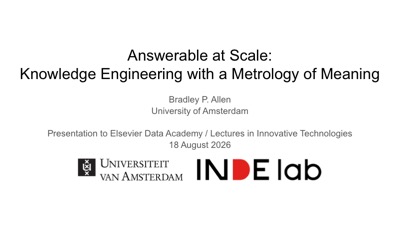 Answerable at Scale: Knowledge Engineering with a Metrology of Meaning — Elsevier Data Academy / Lectures in Innovative Technologies, 18 August 2026. Slides
-
 Knowledge engineering with large language models — interview, Weaviate Podcast #139, 1 June 2026. Video
-
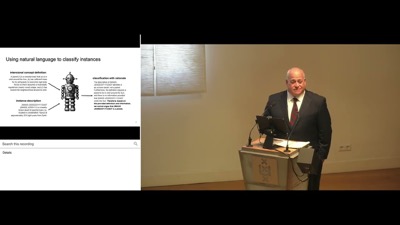 PhD thesis defense layman's talk — University of Amsterdam, 30 April 2026. Video · Slides
-
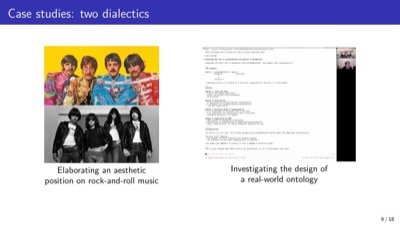 Elenchus: Generating Knowledge Bases from Prover–Skeptic Dialogues — invited talk, Commonsense AI group, Vrije Universiteit Amsterdam, 29 April 2026. Slides
-
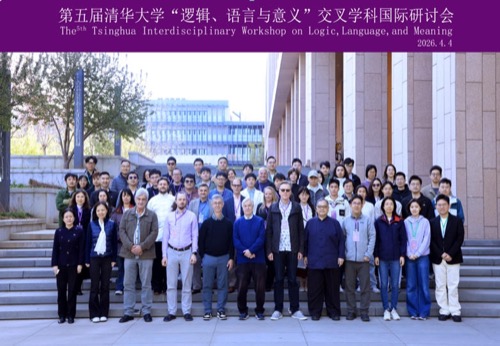 BBL: A Bilateral Modal Logic for LLM Factuality Evaluation — TLLM 2026, Tsinghua University, 3 April 2026. Slides
-
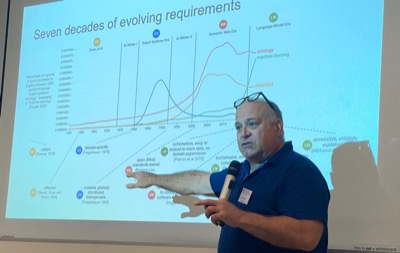 A Brief History of Knowledge Engineering: A Practitioner’s Perspective — invited talk, Dagstuhl Seminar, 12 September 2022. Dagstuhl Reports
-
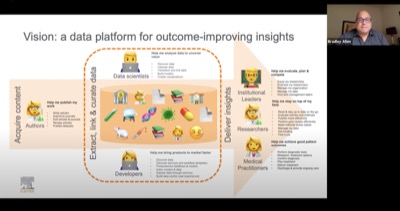 Data science in practice at Elsevier — Harvard Data Science Initiative Industry Seminar, 15 September 2020. Video
-
 Oral History of Brad Allen — Computer History Museum, 16 May 2018. Video · Transcript
- Neurosymbolic Knowledge Engineering with Natural Language. Bradley P. Allen. PhD thesis, University of Amsterdam, 2026.
- Conceptual Engineering Using Large Language Models. Bradley P. Allen. In Vincent C. Müller, Leonard Dung, Guido Löhr, and Aliya Rumana, editors, Philosophy of Artificial Intelligence, Synthese Library, vol. 533. Springer, Cham, 2026.
- Elenchus: Generating Knowledge Bases from Prover–Skeptic Dialogues. Bradley P. Allen. arXiv:2603.06974, 2026.
- Sound and Complete Neurosymbolic Reasoning with LLM-Grounded Interpretations. Bradley P. Allen, Prateek Chhikara, Thomas Macaulay Ferguson, Filip Ilievski, and Paul Groth. Proceedings of the 19th International Conference on Neurosymbolic Learning and Reasoning (NeSy 2025), PMLR 284:392–419, 2025.
- Standardizing Knowledge Engineering Practices with a Reference Architecture. Bradley P. Allen and Filip Ilievski. Transactions on Graph Data and Knowledge, 2(1):5:1–5:23, 2024.
- Knowledge Engineering using Large Language Models. Bradley P. Allen, Lise Stork, and Paul Groth. Transactions on Graph Data and Knowledge, 1(1):3:1–3:19, 2023.
- Case-Based Reasoning: Business Applications. Bradley P. Allen. Communications of the ACM, 37(3):40–43, 1994.
- Job-Shop Scheduling: An Investigation in Constraint-Directed Reasoning. Mark S. Fox, Bradley P. Allen, and Gary Strohm. AAAI, pages 155–158, 1982.
Copyright © 2026 Bradley P. Allen. Last updated 13 October 2026.